Starbucks Mobile Ordering Kiosk
Starbucks has become a popular destination for mobile ordering, allowing customers to customize beverages and skip traditional checkout lines. While the mobile ordering experience offers convenience, the customization process can become overwhelming, particularly for users unfamiliar with Starbucks' extensive menu options.
This project examined how visual search principles and cognitive load impact users' ability to customize drinks efficiently. Through observational research and UX analysis, I identified opportunities to simplify the ordering process and designed a self-service kiosk experience that reduces decision fatigue, improves discoverability, and streamlines customization workflows.
12 Weeks
UX/UI Designer
Food & Beverage
Figma, Adobe Illustrator
User Observation • UX Research • Cognitive Psychology Analysis • Prototyping
Challenge
The Starbucks ordering experience requires users to navigate multiple screens, process large amounts of information, and make numerous customization decisions before checkout. Through observational research, it became clear that users often struggled to locate specific options, experienced frustration when presented with too many choices, and spent significant time searching for common customizations. These issues increased cognitive load and created unnecessary friction throughout the ordering process.
Solution
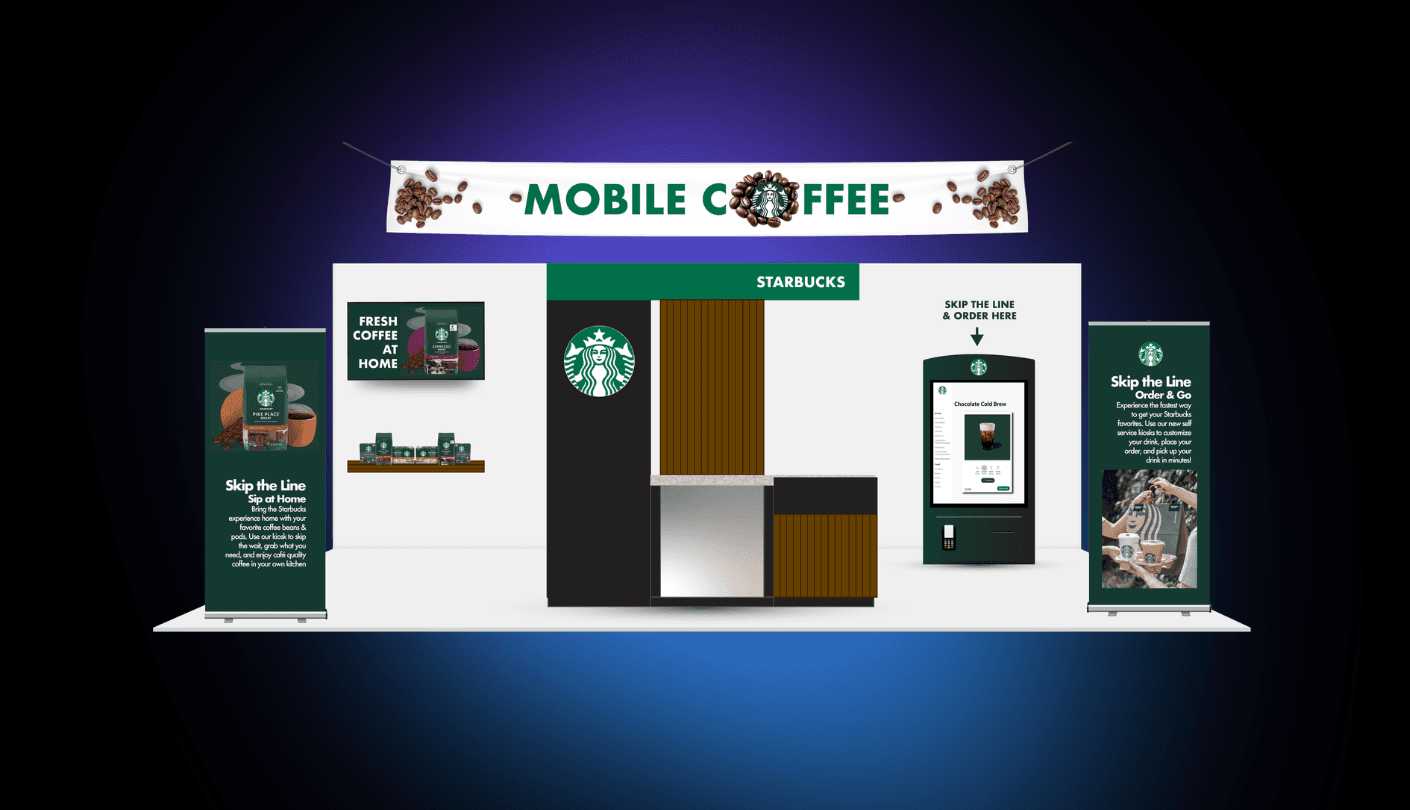
I designed a self-service kiosk experience that allows customers to independently browse products, customize drinks, review orders, and complete transactions.
The design focuses on reducing cognitive load through guided customization, clear navigation, and a streamlined checkout process. Large product imagery, intuitive category navigation, and a persistent order summary help customers move through the ordering process confidently while maintaining visibility of pricing and modifications.
To support adoption, the experience was expanded beyond the kiosk itself through environmental graphics and in-store signage that encourage customers to engage with the self-service experience.
Process
Research & Observation
Conducted observational studies with participants of varying familiarity levels with Starbucks mobile ordering. Participants completed drink customization tasks while task completion time, navigation behavior, and frustration levels were recorded and analyzed.
Cognitive Psychology Analysis
Applied principles of visual search, attention, memory, and cognitive load theory to better understand why users experienced difficulty locating information and making decisions. Research findings were used to identify opportunities for reducing mental effort throughout the ordering experience.
Opportunity Identification
Analyzed recurring pain points including menu complexity, fragmented customization flows, excessive decision-making, and poor discoverability of frequently used options. These findings informed the overall design strategy.
Wireframing & Prototyping
Developed wireframes and interactive prototypes that streamlined drink customization through improved information hierarchy, clearer visual organization, simplified navigation patterns, and grouped customization options.
Conclusion
This project demonstrated how cognitive psychology and UX design can work together to improve complex digital experiences. By applying principles of visual search, memory, attention, and decision-making, the proposed kiosk experience creates a more intuitive and efficient ordering process while maintaining the customization flexibility that customers expect from Starbucks.