Governance From Below
Governance From Below is a nonprofit organization that promotes child-adult mutual leadership through research, education, and public dialogue. The organization approached our team to evaluate whether its website effectively communicates its mission, governance framework, and opportunities for user engagement.
Through a comprehensive UX evaluation, we identified significant usability, accessibility, and information architecture issues that prevented users from understanding the organization's purpose and navigating key content. The project focused on transforming a complex and difficult-to-navigate website into an experience that better supports learning, engagement, and participation.
6 Months
UX Researcher & UX/UI Designer
Non-Profit
Figma, FigJam, Google Forms
Heuristic Evaluation, Accessibility Audit, User Surveys, Persona Development, Usability Testing, Information Architecture, Wireframing, Prototyping
Challenge
Initial research revealed that users struggled to understand the organization's mission, locate key information, and navigate the website effectively. Content was dense and overwhelming, navigation lacked clarity, and users frequently relied on excessive scrolling rather than navigation menus to find information. Many participants expressed interest in the organization's mission but lacked confidence in the site's credibility and structure.
The challenge was to redesign the experience in a way that improved content discoverability, clarified the governance model, reduced cognitive load, and created clear pathways for users to learn, explore resources, and get involved.
Results
Following the redesign, employee engagement with the intranet increased by 45%, and the time spent on the platform rose by 30%. The new interface and improved content organization made it easier for employees to find information and collaborate. Feedback from employees was highly positive, with satisfaction ratings increasing from 3.5 to 4.6 stars.
Process
Heuristic Evaluation
Using Nielsen's 10 Usability Heuristics, our team identified numerous usability issues related to navigation, content hierarchy, consistency, and discoverability. Several findings were classified as major or critical, including the absence of search functionality, unclear navigation, weak wayfinding, and insufficient support resources.
Accessibility Audit
A WCAG-based accessibility audit uncovered several barriers affecting usability for assistive technology users. Key issues included color contrast failures, missing form labels, improper heading structures, and accessibility concerns that reduced content discoverability and comprehension.
User Survey
We surveyed 34 participants to better understand user expectations, perceptions, and challenges. While most users understood that the site was educational in nature, only a small percentage found the information easy to understand. Many participants reported confusion surrounding the site's purpose, content organization, and navigation.
Persona Development
Using survey findings, stakeholder interviews, and usability data, I helped develop three primary user personas representing students, professionals, and researchers interested in governance, leadership, and social impact initiatives. These personas guided design decisions throughout the redesign process.
Usability Testing
To better understand real user behavior, we conducted moderated usability testing with 20 participants across six key tasks. Testing focused on users' ability to locate the organization's mission, understand the governance model, find supporting resources, and identify examples of real-world implementation.
Key Findings
54.2% overall task success rate
36 usability issues identified
90% of users struggled to locate the organization's values
Only 35% successfully located governance model information
75% of users were unable to locate supporting resources efficiently
Users consistently reported confusion regarding content structure and navigation.
Design Process
Information Architecture Redesign
One of the largest challenges was the site's fragmented structure. Key information was spread across multiple pages, making it difficult for users to understand how content related to one another.
To address this issue, I helped restructure the site's information architecture by:
Consolidating related content into logical sections
Creating dedicated pages for key concepts
Improving navigation grouping and hierarchy
Introducing search functionality
Creating a structured footer and sitemap experience
These changes reduced navigation friction and improved content discoverability.
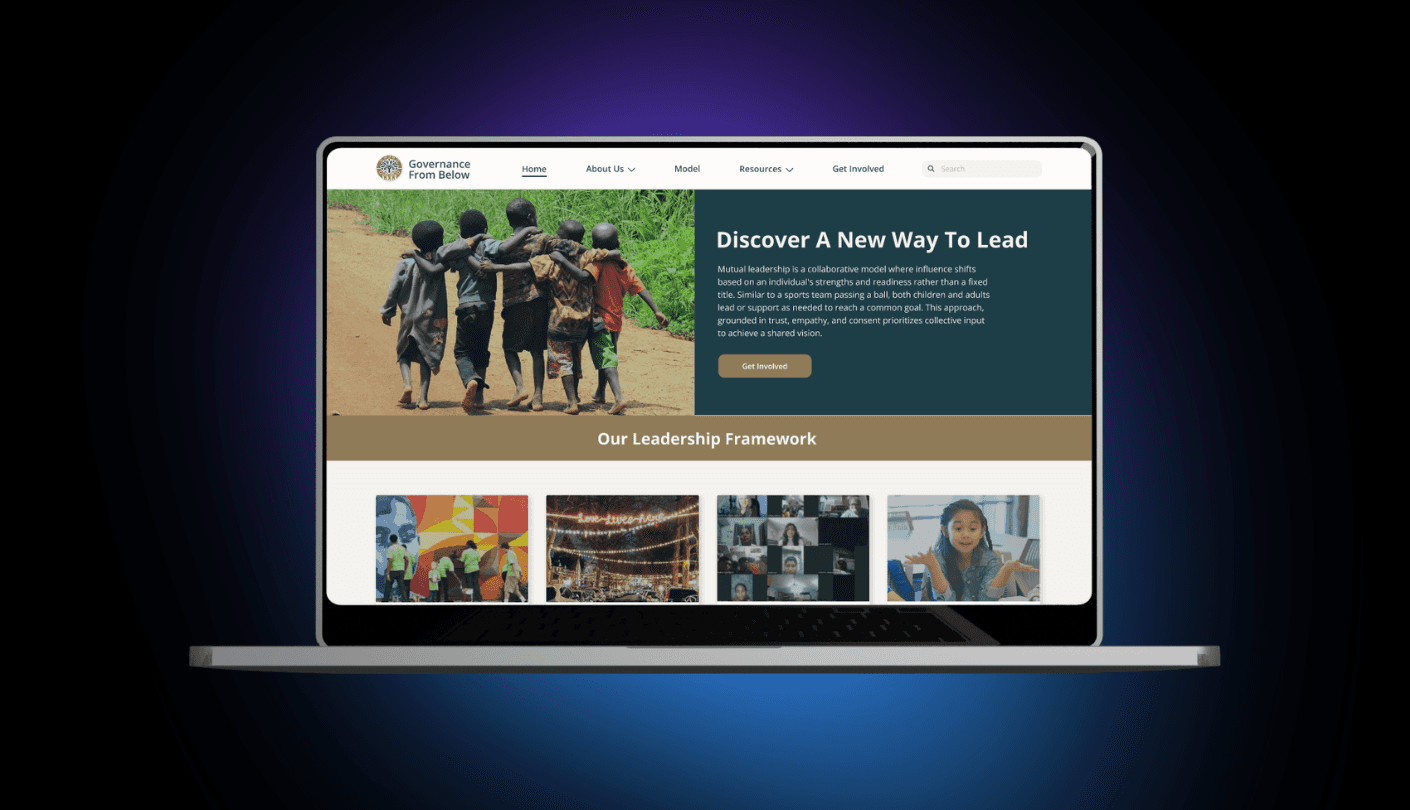
Homepage Redesign
Research showed that users struggled to understand the organization's mission upon landing on the homepage.
The redesigned homepage introduced:
A clear hero section
A concise mutual leadership definition
Improved visual hierarchy
Summarized content blocks
Direct pathways to deeper content
This created a stronger first impression and improved understanding of the organization's purpose.
Governance Model Simplification
Users frequently expressed confusion about the governance framework and had difficulty locating explanations of how the model worked.
To improve comprehension, I helped centralize governance content into a dedicated Model page featuring:
Simplified language
Clear content hierarchy
Improved terminology
Stronger calls-to-action
Structured educational content
This reduced cognitive load and supported easier learning.
Resources & Case Studies
A significant credibility issue emerged during testing: users struggled to find evidence supporting the organization's claims.
To address this, the Resources section was redesigned using:
Card-based content layouts
Dedicated case study pages
Video content integration
Related resource recommendations
Improved content attribution and sourcing
These changes made educational materials easier to find and strengthened perceived credibility.
Final Solution
The final redesign transformed Governance From Below into a more accessible, understandable, and user-centered experience by improving navigation, simplifying content, strengthening information architecture, and surfacing critical information more effectively.
The redesign included:
Homepage redesign
Navigation and footer restructuring
Dedicated governance model experience
Resources and case study hub
About section restructuring
Centralized "Get Involved" experience
Accessibility improvements
Search functionality
Conclusion
This project demonstrated how research-driven design can significantly improve the accessibility and usability of complex educational content. By combining heuristic evaluation, accessibility auditing, surveys, persona development, and usability testing, our team identified key barriers preventing users from engaging with the organization's mission.
The resulting redesign provides a clearer, more intuitive experience that supports learning, improves content discoverability, and creates stronger pathways for user engagement and participation.